Showing posts with label School Reform. Show all posts

Thursday, July 11, 2013

Monday, July 8, 2013

Class Sizes Are Not The Only Things Growing

Corporate decisions are to families what a hurricane is to a growing tree. 


Perhaps you have seen that the latest jobs report came out.  Only 47% of adults are working full time.  
“The report, however, also provides clear evidence that the the nation is splitting into two; only 47% of Americans have a full-time job and those who don't are finding it increasingly out of reach.” 
  
If you are in the “middle” of your life, you probably know plenty of hard-working friends that in this past month have lost their jobs.  It's the end of the corporate quarter.  It’s reorganization time.  Out with the old, in with the new and the less expensive. 


And, the mantra has been that schools should be run like businesses.  However, in education, reorganization is called “reform.”


Reorganize... Reform, right?!  Good for the nation!  Good for the future!  Cut expenses, make money and it will all trickle down and water the trees.  Growth.


You have seen the growth:
  • Swelling tax loopholes (for large corporations, not average citizens) squeezing budgets into deficit.
  • Emerging markets and budding privatization schemes that transform public community resources into for-profit entities – all the while devouring taxpayer funds.
  • Advancing families as “human capital” and updating cheaper labor tactics.
  • Rising middle and lower class debt through pay-cuts and underemployment.
  • Prune more for growth and a better future…


Do we really understand the kind of gale force winds that are stirring?  The kind of growth in wealth that is our country?  A Harvard business professor and economist, asked that very question.  You may find the answer and the reality a bit shocking:


In cash-strapped economic times, it is comforting to know that CEOs are shamelessly making 273 times the wages of the average worker yet blaming “greedy” teachers.  Even the New York Times Executive Pay Report details a 16% growth for CEOs these difficult economic times. 

Can we question why we have difficult economic times?  Why are these times so much more uncertain?  Here's a quick journey back in time to CEO vs. average worker salary ratios:

CEO to Average Worker
  • 1965:  20.1-to-1
  • 1978:  29.0-to-1
  • 1995:  122.6-to-1
  • 2000:  383.4-to-1 
  • 2012:  272.9-to-1, far higher than it was in the 1960s, 1970s, 1980s, or 1990s.

The Economic Policy Institute report shows:
"From 1978 to 2012, CEO compensation measured with options realized increased about 875 percent, a rise more than double stock market growth and substantially greater than the painfully slow 5.4 percent growth in a typical worker’s compensation over the same period."


 Diane Ravitch points out:
Think how busy they must be outsourcing jobs to low-wage nations. Tough job, but someone has to do it.


So, growth is accepted everywhere.  CEO compensation… class sizes… underfunded school formulas… school closures... “experts”… overregulation…


Have you seen what else is growing?

Opposition.


Sunday, June 2, 2013

The story of ALEC: Help us write the ending (repost)

Repost from Education Votes:
http://educationvotes.nea.org/2012/04/12/the-story-of-alec-help-us-write-the-ending/

The story of ALEC: Help us write the ending

TAG , , , , , , , , 

By Amanda Litvinov / photo by neptunecanada
If a children’s book were written about ALEC, the group that bills itself as an association of conservative lawmakers and supporters, it might be called “The Very Greedy Octopus.” It would read like one of those creepy 19th-century fairly tales that most parents would never, ever read to their young ones—it’s just too scary.
For nearly four decades, the American Legislative Exchange Council has been working in the shadowy deep to rewrite the nation’s laws in favor of the wealthiest corporations and CEOs, no matter the loss to working families, communities of color, the environment or public education.  One sad chapter in the book would tell how that sneaky, selfish octopus saw a school of fish and thought, “Hey, these schools are everywhere—how can I cash in?”
That’s right: ALEC has made it a top priority to fundamentally change the nation’s public school system, not only to divert taxpayer dollars to money-making ventures, but also to squeeze the life out of the unions that protect educators’ ability to advocate for students. Education-focused ALEC bills are tailored state to state, but many push to:
  • Privatize education through charter schools, voucher programs and tax incentives, obscuring these programs’ true purpose with positive names like “parent choice” and “innovation schools”
  • Clear the way for online (often for-profit) at-home schooling options that benefit corporations, not students
  • Reduce local control of schools by school boards and parents, and increase the influence of the private sector
  • Use “marketplace standards” to evaluate educators and students, which means more standardized testing and reporting
  • Obliterate the unions that help keep our tax dollars working for students and schools
Trampling public education is just part of the story of ALEC—it has lots of other arms out there, and one has a chokehold on voters’ rights. The group’s efforts to disenfranchise those most likely to vote ALEC members out of office through laws meant to confuse and disqualify them on Election Day are well documented.
But this greedy octopus might finally have reached too far. After exercising unprecedented influence in the 2010 midterm elections, ALEC coordinated an attack of shocking anti-collective bargaining bills across the country. The eventual results were a public uprising and new scrutiny. In Wisconsin, 1.9 million people signed petitions that put Gov. Scott Walker on notice: He faces a recall election this June. In Ohio, a citizen veto overturned the part of SB 5 that would have stripped public employees of collective bargaining rights. The backlash prompted other lawmakers to back off of some of their worst anti-worker proposals, and spurred new efforts to reveal ALEC’s involvement.
Broad public awareness of ALEC multiplied exponentially when it was revealed that the group is behind the “Stand Your Ground” gun law meant to protect the man who shot unarmed Florida teenager Trayvon Martin in February. Intense media coverage and anti-ALEC petition campaigns  have flourished since the incident.
Over the past week, some of ALEC’s powerful corporate members (Kraft, Coke, Pepsi, McDonalds and Intuit) have pulled out of the group. You can sign onto a petition asking more corporate members—who pay up to $25,000 each year in dues, providing nearly all of ALEC’s $7 million annual budget—to stop supporting ALEC’s destructive agenda.
And now some legislators are breaking those ties, too. Yesterday Rep. Mike Colona (R-MO) said in a statement that ALEC ”is not the innocuous, bipartisan organization it purports to be. Their agenda is radical and wrong for Missouri. I was a member and saw firsthand the sort of extreme legislation they push on state legislators around the country. I disagree with ALEC’s extremist agenda and encourage my colleagues in the Missouri General Assembly to end their affiliations with the group.”
Keeping the spotlight on ALEC’s power grabs is an important step in loosening its grip. The Center for Media and Democracy offers tools on its truth-seeking website, alecexposed.org, that everyone can use to better understand how ALEC operates and to track ALEC-sponsored bills in their state.
You can co-author the ending to this story: Help us make sure the Very Greedy Octopus gets his comeuppance!
  1. Sign our petition asking lawmakers to close the very corporate tax loopholes that groups like ALEC have worked so hard to create.
  2. Go to alecexposed.org to see whether your state legislators are members; if so, pressure them to resign their memberships. (Remember, access to lawmakers is what keeps corporations involved.)
  3. Forward articles about ALEC, and share them on your social media networks to help expose how ALEC wields power over public schools and the middle class.

Saturday, June 1, 2013

The Current School Reform Landscape: Christopher H. Tienken and Common Core Examples

First, watch this video, then see the Common Core aligned examples below.  


"The standards are an example of data-less decision making 
based on this long held myth about education 
that if we standardize the knowledge for all students  - 
that somehow that's a good thing."

"The common core standards are simply another version of 
imitate and regurgitate... 
shouldn't we be moving beyond that knowledge imitation?"

"We need to expand, enrich and diversify."


Examples:


Thursday, May 30, 2013

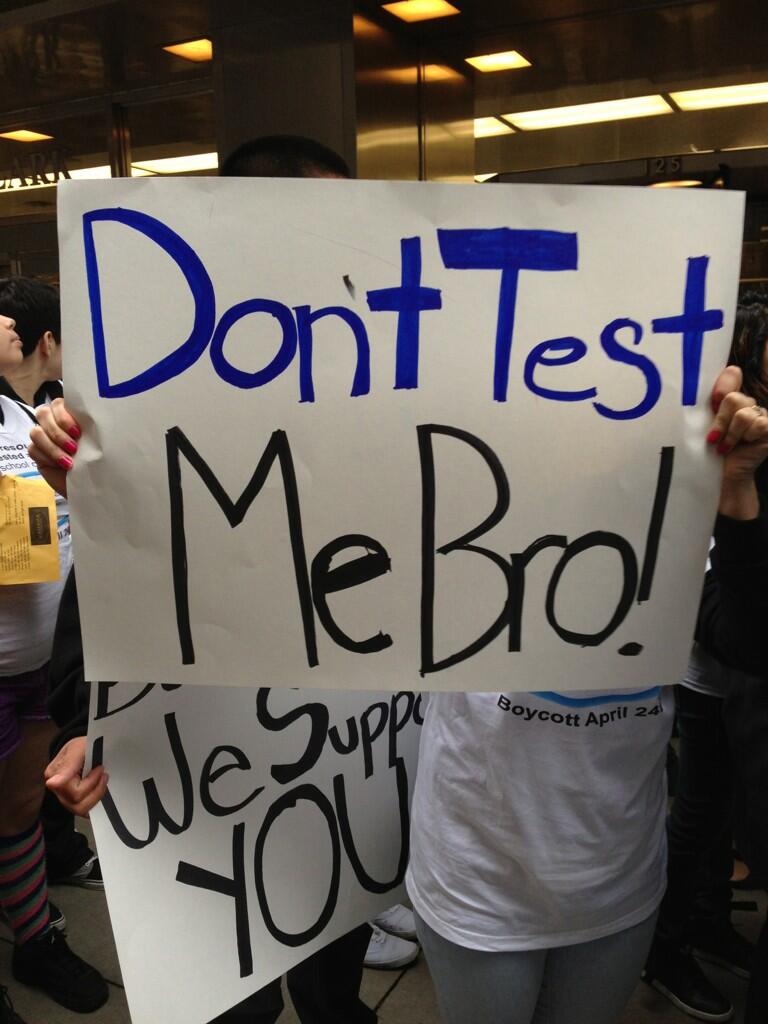
Why We Refused the NYS Assessments (repost)

Repost from the 999ers:  (with highlights by ShedLightNow)
http://the999ers.wordpress.com/2013/05/14/why-we-refused-the-nys-assessments/

Note from ShedLightNow:  This whole piece could have been highlighted.  The highlights merely signify a resounding "YES!"  Read the full piece for a complete and informed perspective:


Why We Refused the NYS Assessments

“First they ignore you, then they laugh at you, then they fight you, then you win.” -Mahatma Gandhi
Let me start out by stating that I am not a testing or assessment expert. Nor is my wife. We are both career educators, former elementary teachers, and college educated through teacher preparation programs. More importantly, we are concerned parents who began watching and tracking Common Core implementation and the rapid, unproven, movement towards more high-stakes testing in our state, New York. Currently, our 3rd grade son is doing very well in school. He’s a good test taker (whatever that means) and wasn’t concerned about the new NYS assessments…except for one fact. He once stated to us that he was a little worried about them because he thought his scores on them would determine if he went on to 4th grade (they don’t). Why would an 8-year old even have to worry about that?
This post would be so enormously long if I went into detail with every little item that influenced our decision. Instead, here’s our bullet point reasons for going all “999″ this spring. What may sound like paranoia, is really the connecting of the dots, so to speak, for us as parents and educators.

1. Common Core (background here)

- Someone else has already decided for teachers what should be taught and when and that someone is government. While the Governors Association and those who defend it have stated there was significant teacher input, hundreds of others refute that. When all I see my son doing is “Common Core aligned”, Pearson stamped, worksheets I know the truth. These standards were not written primarily by teachers (the group is referred to as “the secret 60”) writes Anthony Cody in 2009 (only 1 teacher) here and here. Yes, one teacher involved in the process.
- There are no standardized kids. Why the focus on so many standardized tests? The flawed assumption made by the writers of the Core was this: all children at a particular grade/age are all the same. They should learn the same, move at the same pace, and the outcome should all be the same (achieving a “proficient” score).
- We will have a child in kindergarten next year. Look at what Common Core has done to that age group and their teachers. This is “homework” for a 5 or 6-year-old?
- Our concerns are less at the moment with the actual standards themselves, but more towards the actual rushed,  untested, unproven implementation of them. We are told over and over again that these are “internationally benchmarked”, ”robust,” “aligned with college and work expectations,” “rigorous,” and “evidence-based.” None of this is true. This is one huge, costly national “experiment”.
- There was minimal public engagement in the development of the Common Core. Their creation was neither grassroots nor did it emanate from the states.
- We’ve spoken with both preschool and early elementary educators who can’t believe how developmentally inappropriate the standards are. We have allowed our children’s childhood to be stripped from them. And for what? To get the 5-year old ready for his/her career? What other successful, happy, developed nation is doing that? Do you think that most students by the end of kindergarten are developmentally capable of writing a paragraph complete with a topic sentence and details? That is what the Common Core demands of five-year olds. Tell me, does this look like fun when learning math? Or, conformity? Kindergarten literally translated from German means “children’s garden.” Listen to Sir Ken Robinson talk about creativity in schools (or the lack thereof) here andhere. His quote has been ingrained in my mind for the last two years: “I can’t imagine that there is a kid in the world who gets out of bed in the morning wondering what they can do to raise their country’s reading standards.”
- Common Core, for parents, has become an information dump. Just read through this widely circulated “memo”, posted right on the front page of our local school district’s web site. Get all that?
- The only state to have administered Common Core tests so far, to date, is Kentucky. The number of students who scored ‘proficient’ or better in reading in math dropped by a third or more depending on grade level. Why weren’t both CCSS and the new testing not field tested AT LENGTH, maybe for a two-year minimum across several states before a nationwide push to adoption? Why the rush to adoption? Easy answer – follow the money.
- CCSS implementation is only in full just being rollout this year in NYS. Testing on it, already?
- Many states are currently looking to get out, or “pause”, Common Core implementation. Review the Bill Status Tracker here. Ask yourself, “Why are they doing this after agreeing to adopt CCSS?” At time of this posting, Indiana was the latest to pause CCSS implementation.
- Here is a direct quote from the NYSED website on the Implementation of the Common Core Standards: “Instead, the results from these new assessments will give educators, parents, policymakers, and the public a more realistic picture of where students are on their path to being well prepared for the world that awaits them after they graduate from high school.” Results? We are told repeatedly that all we (and teachers) will see is a number indicating proficient or not. Are these tests given to students ages 8-14 really going to explain developmentally whether a child is ready for college or a career? Every child develops psychologically at different times in their lives. But, the state doesn’t care about that.
-
“The creators of the Common Core standards have now taken jobs with testing companies which stand to make millions of dollars developing tests based on the standards they created.”  In fact, the main developer of the Core, David Coleman, now works for the College Board. Yes, that College Board.  More here
- NY State’s exclusive $34 million contract with Pearson to supply all the materials we will ever need to “be proficient”. That’s just what has been agreed upon to date, on record. Enough said. More on this topic, in-depth, at a later date.

2. Over-testing

- High stakes testing is not about learning; it’s about penalizing.  Because of the wide spread use of these scores, it forces good teachers to teach-to-the test. We’ve seen it first hand where the worksheets sent home day-after-day for homework look exactly like practice test questions, whether old practice questions or some items taken directly from the engageNY web site (where they don’t call them practice test questions).
- This is what we’ve seen this year with our 3rd grade son: benchmark testing, weekly “regular” end of unit type tests, CoGATs, NYS ELA, NYS Math, end-of-year benchmarks, etc. And that’s all just thrown at the 8/9 year olds as if  they can handle all that. Three years ago, Grade 3 testing time was 160 minutes.  This year, Grade 3 testing time was 410 minutes.
- What we need are more leaders like Montgomery County (MD) superintendent whocalled for 3 year moratorium on standardized testing.
- Standardized testing does not encourage the genius in every child. It stifles creativity and curiosity and leads students to believe that there is always only one right answer for any, and every, problem, and one right way to get there.
- It has created an educational system overloaded with worksheets and drill, skill, and kill.
- Tally up ALL the prep time spent on the tests. All of it, not just the practice tests in class, but those sent home (many over vacation time periods), the days teachers are away to learn about all the testing procedures, etc. All wasted instructional time that teachers could be using to further the learning in our classrooms.
- The relationship of the new testing to teacher performance has never been tested and is challenged by educational experts over and over. Why go with a full on, national shift to implement untested practices and procedures? No one at the state level is listening.
- I hate to say it, but as I understand testing, this is all just the beginning.
- Students are given discrete reading passages they have never seen before and expected to answer questions about them, supposedly demonstrating certain “skills”? Since I’m writing this after the spring NYS testing period, hundreds of stories and posts have been written about the testing experiences. Take a look at the NYS ELA Feedback forum and read the comments. Wonderful, eh?
- Anecdotes like this one abound online: ”Bonnie Strope teaches second grade in Odessa-Montour schools. She spoke against high-stakes standardized tests for students in kindergarten, first and second grades. A member of the Odessa-Montour Teachers Association, she recounted witnessing kindergarten students line up to enter a computer lab so they could learn the skills needed to complete tests by computer. “This is far too young!” she protested.” More here
- Mingled in with all the yearly testing we also have Pearson field-testing (overview). A violation of child labor laws, perhaps? If Pearson wants our kids to take practice tests, then can pay the parents who permit their kids to sit AFTER school time in their testing center to take the practice tests. The fact that districts permit this on school time is a disgrace.
Resources:
Press Briefing on the Harms of High Stakes Testing in NY (at least watch it up to minute 22 or so)
Meeting of Long Island education leaders at Hofstra April 10, 2013, “More Than Just a Number“
Field Tests: Unfair Burden on Students, by Fred Smith
Standardized Testing Creates ‘Toxic Environment’ in Schools, Professor Says
Rochester, NY School Board Member Says Her Son Won’t Take State Mandated Test
Mapping the Backlash Against High-Stakes Testing (Infographic)
Frontline “Testing. Teaching. Learning?” series with great resources (link to interview with IOWA test maker)

Frontline 2001 interview with James Popham, professor and former test maker, about the uses and misuses of standardized tests here and Future of Education interview here

3. Financial cost

- This is one of the big unknowns at this moment. Go ahead, ask your district to provide to you in writing how much they have spent on the move to CCSS and the new testing. Ask them in terms of dollar amounts and manpower hours. I have not seen one district clearly able to identify how much testing, and the move to CCSS, has cost their district. If you can find one, please feel free to comment below. How are districts even supposed to budget for this? I am currently working on a FOIL request for this information anticipating the request to be denied.
- The Rockville Centre Schools Superintendent, Dr. William Johnson, a former president of the New York State Council of School Superintendents, said that his district alone has spent $550,000 to $1 million annually for test preparation and administration. He admitted to “low-balling” that figure.
- “Middletown School District Superintendent Ken Eastwood issued a letter last month calling on state and education leaders to not weigh the test grades in teachers’ evaluation formulas, which he said count toward 25 percent of their evaluation as per state law. The Middletown school board voted last week to urge an end to the over-reliance on tests. Eastwood said student results will still fall largely along socioeconomic lines, regardless of the new standards, tests and evaluations. “People are finally getting totally disgusted with what’s going on here,” said Eastwood. Cost of implementing the tests in the next few years will also increase, according to the New York State School Boards Association. The Association said the cost will exceed the federal Race to the Top money to fund it. That will put the onus to pay for the changes on cash-strapped local districts, said the Association. Districts will eventually be required to take the new tests online, Eastwood said. “When we have to tell parents that we’re going to cut music, art, sports or other programs because we have to implement online testing, that’s when people are really going to go berserk,” he said.” More here
- Many experts have already stated that the shift to CCSS and these new tests has already been well more expensive than the federal RTTT dollars received in return.
Resources:
National Cost of Aligning to CCS report here (Feb 2012 from Pioneer Institute for Public Policy Research) $15.8 billion nationally over 7 years
[Got any New York State information on cost of CCSS and testing implementation? Can't locate ANY specifics on this yet.]

4. Data-mining (note that this topic is so huge right now that I am devoting an entire page to it…in development)

- Data collection begins in kindergarten and will continue through all school years, college, and once that child enters the workforce. Literally the potential for 20 years worth of educational data shared OUTSIDE the district and outside the state level.
- FERPA was quietly adjusted in 2011 so the feds would permit…what? Timing is everything.
- inBloom Inc. and NY State…what a partnership, huh? The Reuters article that really drew national interest in this issue and other relevant info here- Screen shots of what inBloom plans to collect for states. inBloom is passing the buck back to districts to say what can and can’t be sent into the database, but then schools say it is up to state guidelines. It is nearly impossible to get straight answers on this topic right now from anyone. I can’t support these efforts until we get details from districts, the state, the feds, and the database partners.
- CBS2 NY report: Experts, Parents, Lawmakers Blast Database Providing Personal Student Information To Vendors
- The New York State Education Department has committed to participate in a “Shared Learning Collaborative” (SLC) with other states whose assessments reflect the Common Core Standards. The SLC is designed to provide analysis of student data so that teachers can access custom analysis and curricular recommendations based upon it. According to the State Education Department, data security will be protected through legally binding agreements as they understand that “the protection of student privacy is and will remain the priority throughout the development and implementation of SLC.” All districts receiving Race to the Top funding will have their data included in the analysis. So the question, among many others, remains: what data are our schools sending to NYS? What is NYS sharing with the 3rd party companies? Good luck trying to find an answer.
- I am trying to find out specifics from my local district as to what data points, or sets, have previously been shared with the NY State Ed Dept, or what the data sharing plans are for the future. Perhaps I am the first person within this huge district to ever ask or even question this?  I hope not.
Resources:
See my complete page on this topic here
“If not us, who? If not now, when?” – Hillel the Elder

5. Use of the scores

- From Carol Burris resolution against high-stakes testing: “All tests and student results should be available to teachers and parents after test administration. They should be used only to inform parents and teachers about a child’s learning and to improve instruction. Tests should exist to serve students not politicians or for-profit testing companies.”
- There is undue pressure on kids to succeed on tests in order for teachers to have an acceptable evaluation. The pressure comes from many angles. Something is drastically wrong with that picture.
- In NYS, standardized tests were originally developed for evaluating programs in schools. That has dramatically changed as these tests are now tied to receiving money, evaluating teachers, closing schools, and more.
- Whatever feedback is given is not timely as it is sent over the summer. Students, teachers, and parents will have no clue what questions were wrong. Does not seem to drive future instruction now does it.
- Who is being assessed? Teachers? Administrators? Students? The implementation of the new Common Core Standards?
- The minute testing is tied to funding, it loses strength as an assessment tool for student learning. Conformity is then about money, not learning.
- Campbell’s Law: Raise the skates on the test, you corrupt the test. Yup. Good job NYS, done that.
- The tests were originally designed pass/fail and to identify AIS, however, now they are being used as 20-40% of a teacher’s APPR evaluation and that is unjust. In addition, the
tests have become a huge for profit business. Millions of dollars are going to test companies to purchase the test and any preparation materials. What if those millions went to assisting students, buying modern technology, and providing professional development?
- Golfer Tom Watson once said, “If you want to increase your success rate, double your failure rate.” How true.
Resources:
See the resource links up under item #2 above. All relevant here as well.

6. The Corporate, For Profit, Angle

- As much as the rush to implement new testing and CCSS has been a political move, it has also neatly linked big business with education. Perhaps permanently.
- In New York, Pearson Education currently has a five-year, $32 million contract to administer state tests and provides other “testing services” to the State Education Department. It also recently received a share of a federal Race to the Top grant to create what the company calls the “next-generation” of online assessments.
- Pearson is profiteering off our children while using the money to lobby in state capitals for more testing. They have also designed the tests to be so difficult that even the NYSED indicated that the failure rate will dramatically increase this year. I suspect Pearson will swoop in with all new testing guides, workshops, practice tests, worksheets, books, web sites, and tools teachers can use to increase those scores. Oh, and this will all be at a NEW cost to schools. More here

7. Parental rights to direct the upbringing of their children

- Parents’ federal constitutional rights: The Supreme Court has repeatedly held that parents posses the “fundamental right” to “direct the upbringing and education of their children.” Furthermore, the Court declared that “the child is not the mere creature of the State: those who nurture him and direct his destiny have the right coupled with the high duty to recognize and prepare him for additional obligations.” (Pierce v. Society of Sisters, 268 U.S. 510, 534-35) The Supreme Court criticized a state legislature for trying to interfere “with the power of parents to control the education of their own.” (Meyer v. Nebraska, 262 U.S. 390, 402.) In Meyer, the Supreme Court held that the right of parents to raise their children free from unreasonable state interferences is one of the unwritten “liberties” protected by the Due Process Clause of the Fourteenth Amendment. (262 U.S. 399).
In recognition of both the right and responsibility of parents to control their children’s education, the Court has stated, “It is cardinal with us that the custody, care and nurture of the child reside first in the parents, whose primary function and freedom include preparation for the obligations the State can neither supply nor hinder.” (Prince v. Massachusetts, 321 U.S. 158)